Outlining. More like guidelining.

The Twirl and Swirl of Letters

I am a proclaimed pantser. No plot, no problem is my motto. But I think I may have just been converted to this newfangled thing called an ‘outline.’

Lately I’ve been trying my hand at outlining a story. I sat down, merrily plugging in the acts and plot points, figuring out what was to happen when. After a couple of hours of work, I was satisfied. I hit print, so I’d have a copy of the outline for my writing by hand.

You should see my outline. Its covered in scribbles, Xs and notes. Reworkings of events. But its been incredibly helpful, keeping me on target. I’m the sort of person who doesn’t write out one crappy draft (NaNoWriMo excepted). If the beginning doesn’t work, I’ll rewrite it until it does. I think I wrote the opening scene six or seven times, and realized that it would work better if I cut it the first four pages entirely, jumping straight into the action. Once I figured this out, I could move forward. The same has worked for later scenes, reworking until it fits.

I worried that outlining would take the spontaneity out of writing. It hasn’t. If anything, I’ve found that its encouraged the unexpected, in terms of conversation, and character development. Because I know where I am going, I can take my time getting there.

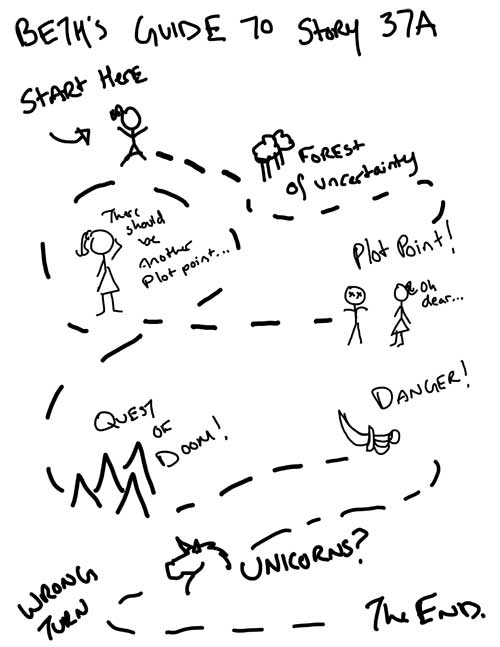
I am going to need a machete to clear out the unessential stuff, but I won’t know what’s essential until I’m done. For now, I’m enjoying the ride, map in hand.

Not actually the plot of the story.

Literary Characters A-Z! Help, please!

The Twirl and Swirl of Letters

The illustrations will be better than this, I swear.

I’m compiling an a-z list of literary characters. I want to illustrate it and make an alphabet book. Because this project combines three of my favorite things: Books, Illustration and Graphic Design. Any suggestions? I’m looking for mostly classic characters, book characters. I won’t use strictly movie or television characters, they need to have originated on the printed page.

Abridgment: A Sign of the Apocalypse or Just Annoying?

The Twirl and Swirl of Letters

Rather than include my usual post about Books that Matter, I thought I’d post my thoughts on abridging books. Please enjoy the rant. Next week, pending the apocalypse, will be back to our regular scheduled program.

This week, I ventured to my local library in hopes of making good on a deal/agreement/suggestion put forth by Holmes: Put aside Hugo and read Dumas. Now, I’m all willing to read Dumas (and have been anxiously looking forward to it), but my library seems to be spiting me.
Why?
Abridged books.
Holmes specifically requested that I read The Count of Monte Cristo (so we can go all former English major on it and DISCUSS). I picked up a copy at my school’s library. Nice, unabridged translation. Had to put it aside as I realized I had a hell of a lot more work to do on the thesis. So, now that I am finished with undergrad, I mosey-ed on down to my local library to get The Count.
Two copies. Both abridged.
Why? I don’t see the point in abridging works, mostly because I feel that if I’m going to put in the effort to read a book, I want to read the whole damn thing. I felt that way about Les Miserables. I feel that way about all books that I read.

Reading abridged books feels like being cheated. I remember my dismay when I realized that those “Great Illustrated Classic” books were abridged (I was a bit slow, despite my reading comprehension, when I was in elementary school). I read their version of Little Women in a day. Imagine my shock when I went to read Little Men (one of the sequels by Louisa May Alcott) a couple of weeks later. It took me nearly a month to read it (bear in mind I was in the third or fourth grade), and I was shocked. Why did this book take me so much longer? Well, it was Alcott’s actual words.

Abridgment.

Now, I would like to know who decides what to abridge. Do you take out the “boring parts?” What, exactly, are the boring parts? I wouldn’t consider Hugo’s many many many digressions to be boring–quite the opposite. I find them utterly fascinating (and I paid more attention to the Waterloo stuff the second time through). So what if we have to read 50 pages of stuff to get to a chapter that ultimately dictates how the last, um, 4/5s of the book play out? Considering the Brick is over 1,200 pages, I think that’s perfectly fair.

Of course, abridging can work to one’s favor. For example: The Complete Works of Wm. Shakespeare, Abridged is one of the funniest plays I have ever seen.

And I can’t think of any more good examples of abridgment.

Excuse me while I bury myself in my unabridged copy of Les Miserables. Now if I read French, it would be even better…

Writer’s Challenge: Interview with a Character

The Twirl and Swirl of Letters

First, this is a challenge put together by Ralfast! And it was good fun.

I walked down Huntington, past Symphony Hall. I took a left and continued down the street, passing a mess of restaurants before finding the one I was looking for. It was a discrete, small building identified only by the top hat/tea cup sign that hung over the door. “Hatter and Hare” it said. I recognized the name, one I had created for a project, but my characters had highjacked. I pushed the door open.

What greeted me was a small, pleasant tea room/cafe. It was elegant, tasteful. The Alice in Wonderland motif was understated, with a few small details scattered throughout. I spotted a few decks of cards, an Alice fireplace grate…I knew there were more.

I sat down at the counter, pen and paper in hand. I said a quick hello to the barista, a normal looking guy wearing a bow tie. My character, and the subject of today’s interview. He put a cappuccino in front of me, which I thanked him for greatly.

“Now, let’s get this over with,” said he with a cheeky grin.

“Right,” I said. “First, what’s your name?”

“Well, you came up with me, you should know. But for the sake of the interview. My name’s Daniel Bentham. I’m twenty-seven years old, own this tea shop, and I like long walks on the beach.”

“Do you really?”

“No. I hate the sand. But it just seemed like the right thing to say,” said Daniel. He laughed and poured brown sugar into his espresso. “Sugar?”

“Please,” I replied, and took the sugar from him. “So, Daniel, do you have any nicknames?”

“My sister calls me Danny or Danny-boy. I call her Charlie and she shuts up,” said Daniel. He raised the white espresso cup to his mouth, inhaling the coffee’s rich, warm scent. He exhaled, closing his eyes. I watched his strange ritual another time before he broke it, taking a sip. “Ah! That’s good coffee.”

“Coffee,” I repeated.

“Yeah. Coffee. It’s my passion. Well, one of them. I like tea a great deal, too. The ceremony that surrounds it. Speaking of ceremony, we had a Royal Wedding viewing party. Opened the shop up early, especially for the day. Served tea and scones with clotted cream and jam…but I’m getting off topic. You were conducting an interview, and I so rudely interrupted with my tangent. Please continue.”

“Do you mind describing yourself for the readers?” I asked, a little embarrassed.

“I thought you said this was a photographed interview!” said Daniel in mock horror. “I can’t do justice to myself! Words fail!”

I crossed my arms. “Try, please. I could write it myself, but I’m sure you would rather describe how you see yourself.”

Daniel cleared his throat. “I’m a handsome devil. I have blue eyes and brown hair and I’ve got plenty of freckles. Slightly taller than average, and a nice smile. No jewelery or tattoos. Happy?”

“Good enough. Hobbies?” I said.

“Coffee. And I like classic cars. And events like the Monaco Grand Prix. I want to go one day.”

“Thanks for giving me a straight answer.”

“You’re most welcome,” replied Daniel. He looked at my cappuccino cup and asked if I had finished. I hadn’t–the foam still remained. “Oh! I nearly forgot. Cooking. I love cooking. Especially eating what I cook.”

“Fantastic.” I wrote furiously. “So, can you tell me about  your family?”

“Well…” said Daniel with a sigh. “I have a mother and a father who are alive and well and currently on vacation somewhere. My sister Charlotte and I manage this tea shop. Dunno where she is…probably out getting ingredients.”

“Where are you from?” I sipped at my cappuccino. It was really good–one of the best I’d had Stateside.

“Depends. I usually just say Boston. Most people don’t know the town I’m from, so I don’t bother saying it.” He shrugged. “Plus, it’s boring.”

“Good enough for me. Now, excuse my prying, but do you have any secrets?” I asked.

Daniel stepped back. “Yeah, ‘course.”

“Mind sharing one or two?” I smiled politely, and put the pen down. I didn’t want to betray his confidence.

He looked at me warily, uncertainty writ on his face. “Yeah. They’re secrets. They stay that way.” He crossed his arms and seemed to be hoping I would leave.

“Fine, didn’t mean to pry. Last one’s tough. What do you believe in?”

“Coffee.”

“Classic, Daniel. Really classic,” I replied.

“I thought you’d appreciate it. Now scram. I need to clean this place up before the lunch rush.”

Daniel’s story takes place in present day Boston, at a whimsical tea shop located near Symphony Hall.
Lost: A Few Impressions

The Twirl and Swirl of Letters

Well. Due to my overseas adventures last year, I missed the final season of Lost as it aired. My friends and I sat down and watched it, finishing the other night.

I wasn’t disappointed by the ending. Sure, they left some things fall by the wayside (such as why Claire could be the only one to raise Aaron, among other things), but ultimately, I was pleased with the ending. I wasn’t expecting a “Fall Out” style mayhem fest–in fact, I would have been sorely disappointed if it came to that. Fortunately, it didn’t.

I came to the end expecting nothing but to be entertained, which I was, so that’s what matters.

I’ve always watched Lost for the characters rather than the sci-fi elements. The human drama has always been the reason why I return; the sci-fi is a nice bonus. As such, the character heavy, ‘we all go off together’ thing worked for me.

I guess what it comes down to is that it isn’t the adventures that we get into, the briers we’re entangled with–its the people we meet, the friends we make, those people who have our backs regardless. It’s our support net, the people who we carry in our hearts, if not actually by our sides.

That’s ultimately what Lost came down to: a story about a group of people who formed a deep bond that ends up being the most important aspect of their lives. It doesn’t matter that Jack is a doctor or that Hurley won the lottery. What matters is the friendship that the Losties formed.

Sunshine and Happiness

The Twirl and Swirl of Letters

A snippet of a conversation between Holmes and I:

Me (holding a copy of The Count of Monte Cristo): “I can’t wait to finish my paper so I can move on to sunshine and happiness!”

Holmes:…

Me: “Sunshine and happiness there being epic, depressing French novels.”

Whenever I finish reading one of Victor Hugo’s books, I feel a big gaping hole in my chest. Since I don’t think my school’s library has anything more of his, I’ve moved onto Dumas. I have yet to start, but I am so looking forward to reading The Count of Monte Cristo.  And get through reading it without slipping up and saying “Monte Crisco.”