Celebrating Hitchcock

General Geekiness
Rear Window

(C) Beth 2011

I find myself writing posts commemorating the death days rather than the birthdays of my favorite artists. As some of them, like Mr Hitchcock and Mr Dahl, tend towards the macabre, it’s rather fitting.

Today marks the 31st anniversary of Alfred Hitchcock’s death. I had intended on watching one of his movies every night this week. That, of course, failed, with my thesis presentation on Thursday. I did, however, manage to see The Birds at a local cinema on Monday night (which was wonderful), and To Catch a Thief on Tuesday. I believe tonight Holmes and I will finally finish watching Sabotage and perhaps watch another of Mr Hitchcock’s films.

Hitch is a director I came to rather recently. I had seen his second version of The Man Who Knew Too Much during my sophomore year of college, but hadn’t seen any of his other movies. Cue Psycho‘s jarring strings. Holmes needed to watch it for a class, and I, the ever ready film viewer hoping to reap the benefits of her class minus the homework. From Saul Bass’s credits, I was hooked.

The film entranced me, so much so that I watched the film several times over the course of the semester, even writing senior thesis number one about Psycho.

Psycho put Holmes and I on a quest: to see as many of Hitch’s films as possible. As he directed 52 surviving movies, we have our work cut out for us. I have fourteen under my belt, which is more than most people can say.

There’s something delightful about working our way through a director’s canon. I wouldn’t have seen many of his movies without this goal. Strangers on a Train, Rope…great movies I otherwise would have ignored.

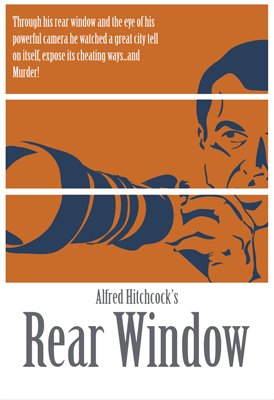
My enjoyment of Hitch’s films have inspired my visual art as well. I’m undergoing a personal project to create a series of posters for his movies. One is completed: Rear Window. I intend on making posters for Psycho, The Birds, Rope and maybe even Strangers on a Train.

So, Mr Hitchcock, thanks for all the movies.

Books that Matter: Over to You by Roald Dahl

Books that Matter

It wouldn’t be a book list of mine without something by Roald Dahl. The difficulty was choosing which of his books to highlight, as I enjoy so many of them.

One kept sneaking back into my mind–Over to You, his collection of RAF inspired tales. Not the first of Mr Dahl’s books that I read, but the one that I have read most frequently.

This book is a collection of some of his earliest work. There’s an elegance to it, a lyricism that delivers a punch straight to the gut. There’s humor in some of the stories, such as ‘Madame Rosette,’ but there is a poignancy to  others that stays, such as “They Shall Never Grow Old.”

I discovered this book shortly after developing my interest in the RAF and the Second World War. It was a fitting match, stories that captured camaraderie and sorrow.

I’ve read most of Dahl’s other adult stories, but these are the ones that stick with me the most.

Edit: Holmes has asked me to clarify something: it was she who reintroduced Mr Dahl into my life, NOT the RAF. However, I stand by my “I chose this book over the others” because of the RAF.

Books that Matter: The Lord of the Rings by JRR Tolkien

Books that Matter

I remember the day I started The Fellowship of the Rings. I was thirteen years old, in the seventh grade. It was mid-December, just before winter break. The first Lord of the Rings movie had just been released, and my family planned on going to see it on Christmas Even.

I had just over a week to read it. I finished The Hobbit the day before. I couldn’t wait to start.

My Language Arts teacher lent me the book. That afternoon, I started to read. The book was dense, but I devoured every word. I finished on December 23, 2001. For Christmas that year, my parents gave me the trilogy. Those copies are dog-eared now, the covers ripped and peeling, the pages still in tact (somehow). I am not certain how many times I read them, but the number is probably close to 20.

The stories captivated me. They entranced me. The elves, the hobbits, the orcs and the men of the West. Gollum. Gandalf. After many readings, my favorite characters have changed. These days, I am very fond of Faramir and Eomer, and Eowyn as well. I will always be fond of Sam as well.

The Lord of the Rings inspired my writing. I discovered it about the time when I determined that I could write novels if I really wanted to. Naturally, my first attempts were blatant rip-offs as I attempted world building, but I soon realized that I could take inspiration from the world. Already a mythology nut, I delved deeper into the Nordic, Irish and Welsh stories, learning and reading.

I also realized, importantly, that making up a language is tough. It wasn’t just random words thrown together. There needed to be continuity, traceable roots, rules, etc. You can’t just chuck vowels together and call it a day. At this time, I also began learning German, followed by Spanish. Seeing how these languages worked gave me great respect for Tolkien’s linguistic capabilities; I’ve resolved to stay away from creating my own languages.

It’s been years since I have read the trilogy, must be senior year of high school. The stories, the characters, stay with me fondly. I look forward to reading them again some day, to bask in the epicness of it all.

Revisiting Old Stories

General Geekiness

I was poking about on my hard drive today when I discovered some stories written through the years. Some of them I wrote over four years ago; its enjoyable to look back and see what I was thinking about then. I reread one of my favorites from that era, a story about super heroes and villains who, apart from being superpowered, are normal folks. I still like my plot and the idea, but I could do a lot with the writing. It has been four years, and I have improved.

The other story is the one that was giving me so much trouble last year. All I could remember from it was that a) I hated the protagonist, b) it is set somewhere in Italy and c) it’s a bit obvious that I adore The Prisoner.  And while I still hate the protagonist (funny, because in rereading I see myself in him. Not a great deal, but enough), I still think the story has potential. I am quite enamoured with the setting and with the basic premise. I had some good descriptions.

I need to revisit the first story, rewrite it so its cleaner, more epic and awesome in scope. I had a pretty decent world built up, I’d like to explore it more.

For the second story, I need to work on defining the main character, the primary antagonist, and the plot. Once I have these elements figured out, I should be able to press forward.

Looks like I’ll have some creative writing projects this summer. Hurrah!

Hand Made Souvenir!

Florentine Scribblings

Well, I’m departing the grand old US of A tomorrow for the last spring break of my undergrad career. I’m going back to Florence (!), this time to visit my sister, who’s studying there (though at a different school than I did).

I recently finished up one of my sketchbooks, but was faced with a dilemma. The one I bought latest is…well…massive. It doesn’t fit in my carry-on, and like hell am I going to lug it across the city (even though I would if I had an art class there…). Anyways, I had a few lineless moleskine notebooks lying around, so I decided to use one to make a trip journal/sketchbook.

I love to write and draw, but rarely do I have a small notebook with me. I’ll be carrying this one so I can sketch and record silly comments whenever I want. I’m also going to tape in all of my train tickets and museum entry passes, restaurant cards, store names, etc.

I am so looking forward to this trip. I cannot wait to return to my home-away-from home.

Look Ma! No Paragraphs!

The Twirl and Swirl of Letters

So, as a counterpoint to the light movies I’ve been watching lately, I’ve started reading Kafka’s The Trial. I’ve never read anything by Kafka, and this work is mentioned rather frequently in the research I’ve done on The Prisoner, so…reading it I am.

One thing that I’ve noticed  about the book is the lack of paragraphs. There isn’t any separation between dialogue; the end result is massive paragraphs that go on for an entire chapter. I find that I can’t skim-read; I must read each and every word to know who is saying what. Otherwise, one missed dialogue tag and I really am clueless.

I hadn’t given much consideration to the separation of dialogue by different paragraphs. It, in my eyes, was a given. A new character speaks and there is a new line.

Not so in The Trial. Lines run together, making it some times difficult to figure out who is speaking when. The result is, though, fitting for the story. The reader, much like main character Joseph K., is left confused. The story, focusing on a man who is arrested and not informed as to what his crime is, leaves the reader in a state of uncertainty. Who is this Joseph K., really? Who are his tormentors? Why has he been arrested?

The lack of separate paragraphs provide a cramped, uncomfortable, almost prisonlike in your inability to escape. The text is closed. When reading, I can’t help but want to escape the bounds of the page, no doubt just as Joseph K. longs to escape the rigid, though ill defined, justice system.

The uncertainty is killing me. But I like it.