Last night, I stood out on the cold Calton Hill with about 10,000 other revelers to banish winter and welcome in summer. We watched the Beltane Festival, a modern reinterpretation of the pre-Christian Spring celebration. We weren’t entirely certain of what we were getting ourselves into, only that there would be fire
The Drummers, Beltane 2012
At nightfall, we moved to the other side of the Acropolis, to welcome the much-needed fire! It was absolutely freezing on Calton Hill–I wore my heavy down coat and shivered more than at Hogmanay (New Year’s celebrations). Unfortunately, being a bit vertically challenged (and in the middle of the crowd), I couldn’t see much more than this, the Processionals lighting the fire.
Lighting the fires
After, we watched some fire dancing (including flaming hula hoops), thoroughly impressed. I’d like to try my hand at it some time.
The night continued on, still freezing cold. There were more processions, dancing, and finally the Green Man and May Queen lit the massive bonfire! Warmth at last!
Dancing by Flames
For more serious information about Beltane, visit beltane.org
To celebrate my second semester being completed, I left Edinburgh for the first time since I went up to Loch Tay in January.
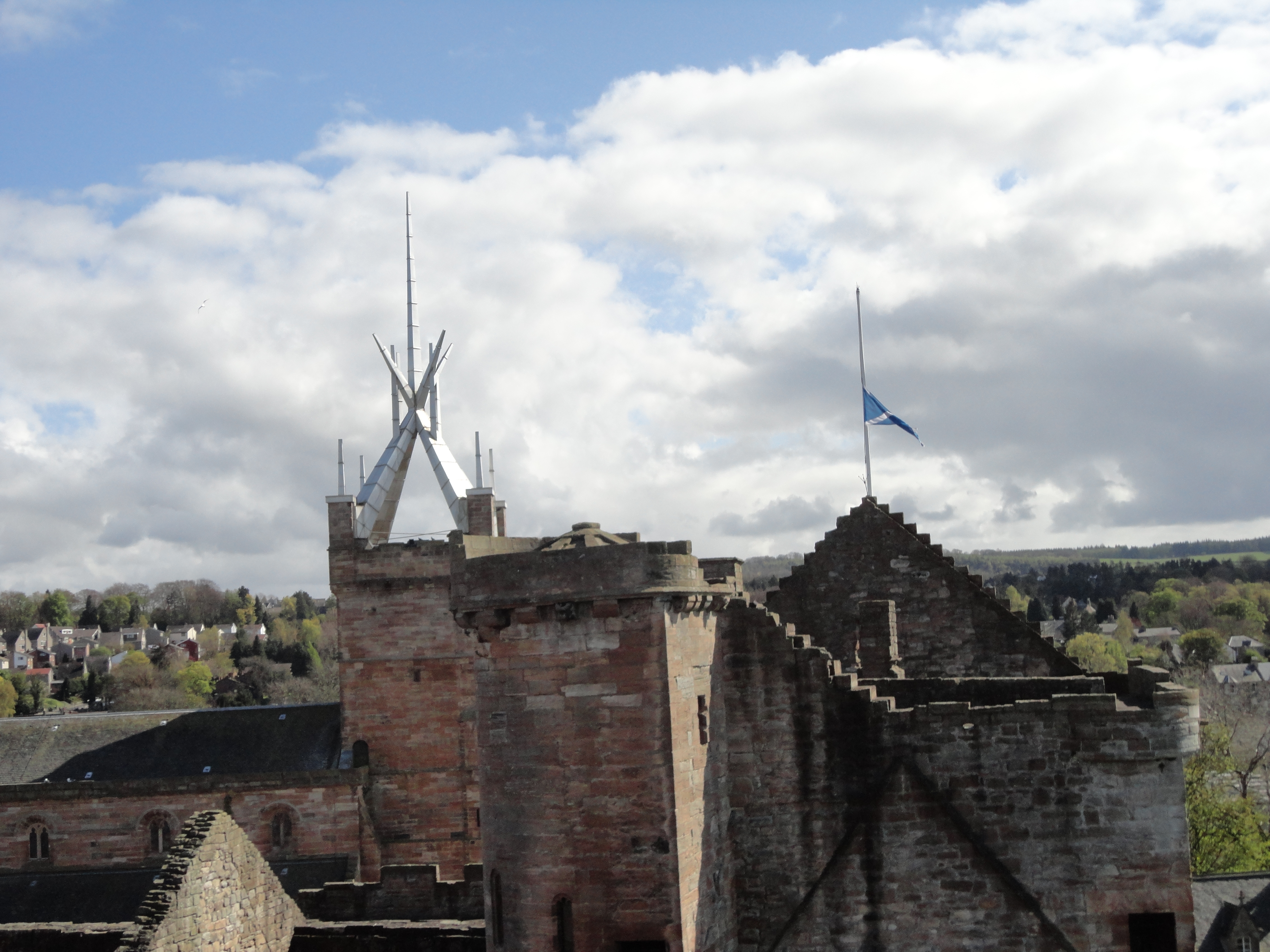
I didn’t travel too far, only to Linlithgow, a town about 20 minutes outside of Edinburgh by train. The main attraction? Breaking in my shiny new Historic Scotland pass. I’d heard good things about Linlithgow Palace, birthplace of Mary, Queen of Scots.
I didn’t know what to expect. I did no research on the palace, only finding out that it was there and I could get in for free with my pass.
I certainly wasn’t expecting a ruined palace. No roof, and slick stone–thank goodness it was a sunny day!
“It may be possible to do without dancing entirely. Instances have been known of young people passing many, many months successively, without being at any ball of any description, and no material injury accrue either to body or mind;–but when a beginning is made–when the felicities of rapid motion have once been, though slightly, felt–it must be a very heavy set that does not ask for more.”
-Jane Austen
I have been bitten by the dancing bug. The jitter bug, one could say. Dancing, swing dancing in particular, is addictive. It is, for lack of a better phrase, my drug. The high that I get from a night of dancing keeps me going through the week, the perfect fix to the Wednesday lows.
Lately, I’ve found that two days a week isn’t cutting it. I want to dance all the time. I was fortunate last week, dancing on Monday, Wednesday and Saturday. But just the same, it isn’t enough. My friends and I are panicking, trying to figure out how we’ll continue with our dancing obsession over the summer months, when the uni society stops running.
Jane Austen speaks the truth. One can do without dancing. But once you’ve started, once it’s grabbed and enthralled, you count the days to your next opportunity.
Music. It calls to me. There’s something visceral about it. It grabs me and twists my gut, weaving its way into my subconscious. Songs stick in my mind, they refuse to leave, perfect ear worms. The above song, “Speedway” by Morrissey is one of these songs (I can’t help it. I move to the UK and I develop a love of the Smiths and Morrissey’s solo stuff). I listen to his stuff while working; I find it to be just the sort of thing I need to get focused.
But enough on Morrissey (for this post).
Music in itself. I find myself drawn to it, perhaps more than any other art form (strange, for a writer/painter/graphic designer). I’m stopped by its sheer incredibility. The range of emotions, the sense of calm, fear, love evoked by notes expresses the human condition more than words or paintings ever could.
To quote Aldous Huxley, “After silence, that which comes nearest to expressing the inexpressible is music.”
The past few months have been difficult ones for me. The coursework has been particularly strenuous in a different way from last term. My health hasn’t been the best (nothing serious, just atrocious colds and uncomfortable back injuries). Things haven’t been going as I had hoped–not poorly, but not as well as my internal narrative wanted.
The other day, I went into St Giles Cathedral to look around. A string quartet practiced for the evening performance. As the violin sang out, the cello setting a steady pace, my heart soared, leaped, fell, felt, repeated. The starting and stopping as the musicians ran through their piece struck me. It was, in its imperfection, exactly as I felt. There was joy, frustration, repetition.
Words failed me. Visual arts failed me. Yet music fit where no other expression would. It was fleeting, yet permanent, the memory to be one of the strongest I have.
My strongest memories are tied around music. The two best concerts I’ve been to have had moments of transcendence–from the Who, when Roger Daltrey sang portions of Tommy, a medley that meant so much to me, given that I had listened to that album ad nauseum the summer before. The second was the Swell Season, when Glen Hansard got the audience to join in on the chorus of ‘Back Broke.’ The effect was haunting, uniting, beautiful. For moments at both of these gigs, the music transcended. That’s all that mattered.
One thing that I try to do every week (or at the very least, every month) is attend events at Inspace, the University of Edinburgh Informatics Forum’s art space. The events I try to attend “blind.” I get the event emails from New Media Scotland, and sign up for the various events. I’ve attended lectures on memory and music (which resulted in my showing my inability to use a turntable in front of 75 people), a Pecha Kucha night (in which I stood up in front of a separate group of 75 and told stories of falling off of Arthur’s Seat), and a presentation by the Information Delivery Service (which resulted in no ridiculous stories from me).
IDS is a student cooperative fascinated with information, its readiness, their desire to have it all. The lecture, which I found interesting, was filled with information overload (and rather disjointed, lacking any coherent narrative flow, from which it would have benefited greatly). It did, however, leave me to contemplate how what we consume and create develops our identities.
I’ve recently started using Pinterest, that incredibly popular photo/lifestyle/dream-sharing website that’s been critiqued for everything from creating desires for unattainable lifestyles to dubious copyright infringement. What’s struck me as fascinating is, apart from its addictive qualities, Pinterest is able to give a ‘look’ to how we identify and how we wish to identify. It’s a means, like the Facebook info page, to divulge bits and pieces about ourselves to the world.
We are what we consume. We’re made up of the books that we read, the music that we listen to, the clothing that we wear. We identify through media, with ourselves and with each other. When getting to know one another, we ask about what sort of books we read, movies we watch, music we listen to. We find common ground and relate to it, often through what we enjoy.
If one were to look at my bookshelf, one would find a few books of critical theory (Guattari, Ranciere, Postman and McLuhan), philosophy (Hume and Marcus Aurelius), novels (John LeCarre and Margaret Atwood coexist, Raymond Chandler recently moved to the bedside table), my DVD collection of The Prisoner, a small CD collection (The Smiths and The Jam), and a few art books (exhibition guide to The Queen Art & Image, the exhibit I saw on my first day in Edinburgh). One can start to suss things out about me, just from what I choose to share about my intellectual consumption. I’m interested in media and environments, spies, and music made before I was born.
I see the world filtered through what I consume. Far too much of what I experience or think about is influenced by The Prisoner, even my potential dissertation topic for this degree. The thought of being without my DVDs in a foreign country was too much to bear. I even started reading books like Le Carre’s for research before realising how much I love them (okay, I’ve always enjoyed these stories, far more than I have the books that I’m “supposed to like”).
And I hate for the pretension that comes with saying, “I am an artist” but it’s true. I am an amateur painter, perhaps someday a professional digital artist (my dissertation, with hope, will kickstart that). But I read books on art, I examine it, I enjoy it, I consume it.




 Ned Wolfe